
Walk in ready.Practise the casesbefore you live them.
Simulated patient consultations, on your time. Practise clinical reasoning, communication, and decision-making: before placement, before the OSCE, before the ward.
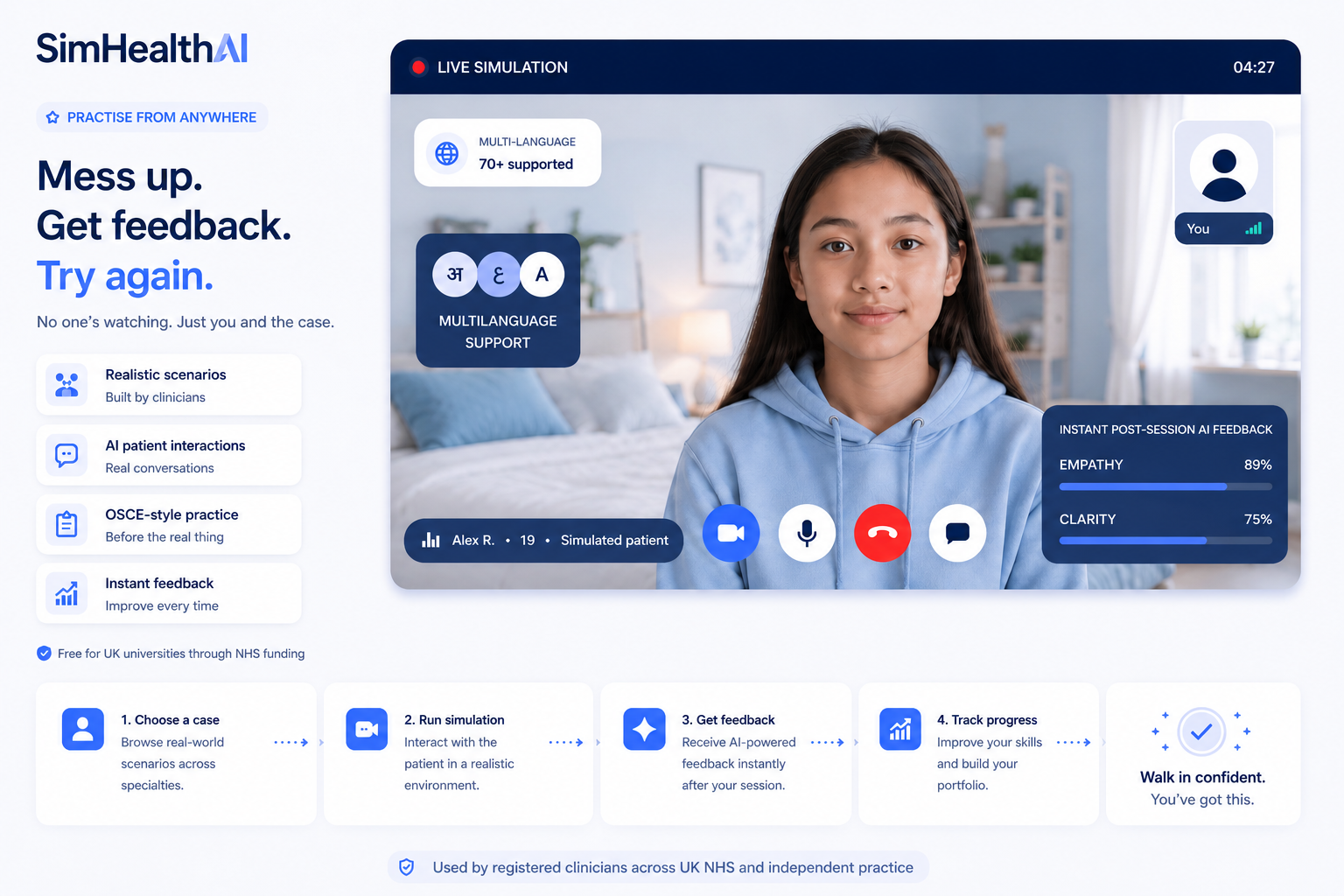






Placement can't show you everything.
Preparation
Walk in ready, not hoping.
Some students want to be as prepared as possible before they set foot on the ward. SimHealth lets you practise the cases most likely to come up, before they do.
Fill the gaps
See what placement hasn't shown you yet.
The patients you encounter are down to timing, location, and chance. SimHealth lets you seek out the presentations and specialities you haven't had exposure to, on your own schedule.
Act on feedback
Turn supervisor notes into practice.
Got feedback on your communication or clinical reasoning? Go back in and work on it with a patient who responds the way a real one would, and try again until it clicks.
The closest thing to placement that isn't placement.
Simulated patients
Live video conversations, not chatbots. Patients respond, hesitate, and follow up just like the ward.
50+ cases across specialities
Weight management, gastroenterology, dementia care, and more. Each one adapts in real time to your decisions.
Instant structured feedback
A 40-point rubric scores empathy, clarity, and triage after every session. Results are yours straight away.
Evidence for your portfolio
Every session is logged and exportable. Proof of practice you can show at OSCE, in interviews, or to your supervisor.
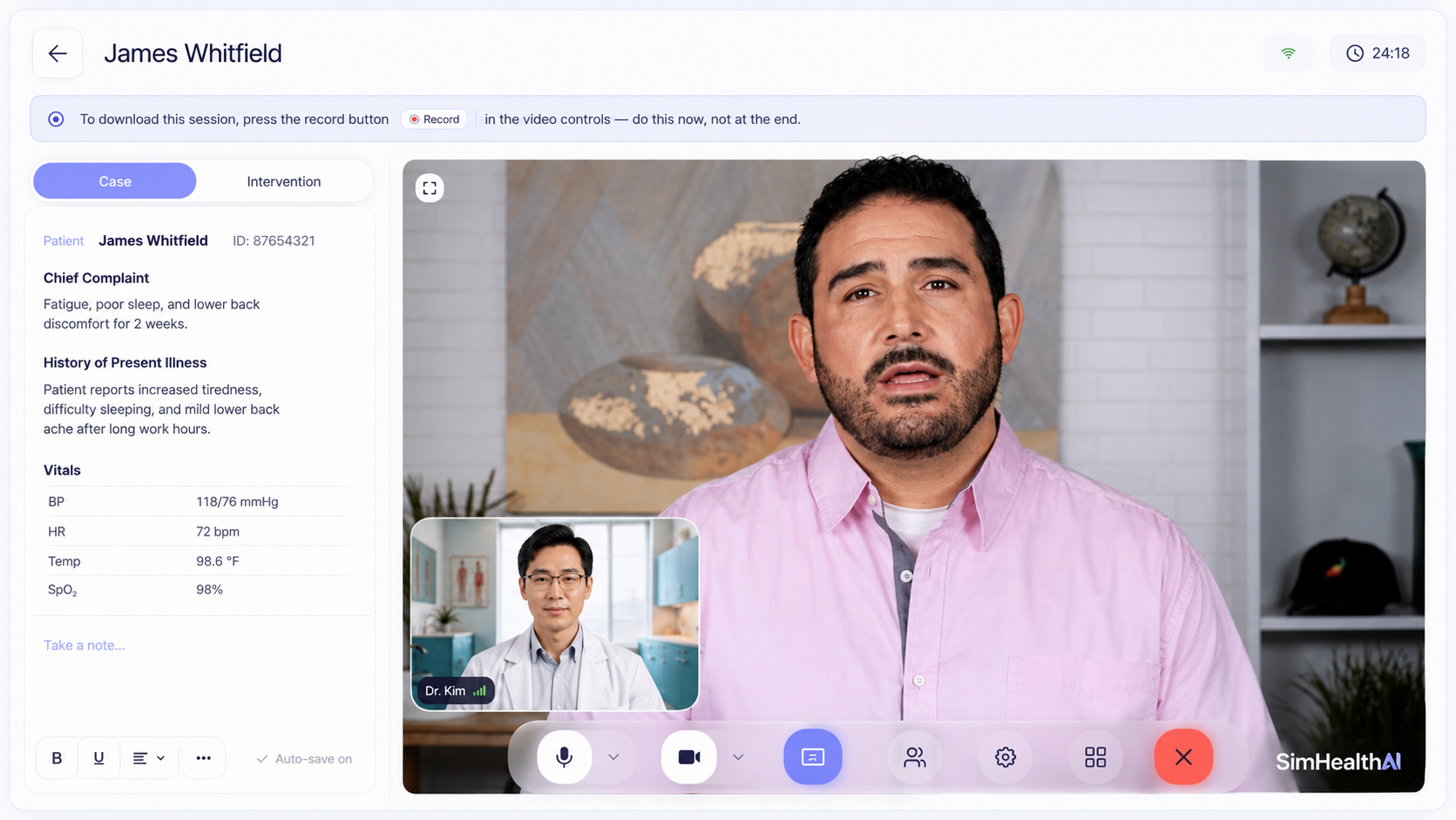
Run a real consultation, before it counts.
Live video with a simulated patient who responds, hesitates, and follows up. Case context, vitals, and your notes stay one tab away — practise the consultation as it’ll actually happen.
Inside a SimHealth session.
- 01
Prepare
Students are assigned cases mapped to programme learning outcomes and placement hour requirements, so every session has a clear clinical purpose before it starts.
- 02
Consult
A real conversation with an AI patient who responds naturally, hesitates, and reacts. Students get the communication practice that only comes from a live clinical encounter.
- 03
Document
After each consultation, students write clinical notes exactly as they would on placement, building the documentation habit that regulators and supervisors will assess from day one.
- 04
Feedback
Every session is assessed against a 40-point competency rubric covering empathy, clinical reasoning, communication, and triage, mapped to the standards your professional body already expects.
- 05
Reflect
Students complete structured self-reflection, engage in peer feedback, and build an evidence portfolio of their learning. Every session becomes something they can point to.
Every session maps to HCPC, NMC, GMC, and BDA standards — so the evidence you generate is recognised by the bodies that already assess you.
“The simulated clinics felt realistic and gave me the confidence to practise my clinical reasoning in a safe space.”
“I genuinely found so much benefit from these four weeks. I'll go into my next placement feeling much more prepared.”
“The realistic case studies allowed me to apply dietetic knowledge in a safe, supportive environment, and the structured feedback helped me grow both professionally and personally.”
“Exactly what I needed to bridge the gap between theory and practice before my placement. I went in more confident and prepared for real-world clinical challenges.”
“A great opportunity to adapt to a real-life scenario, gain confidence in assessing patient cases, and give personalised goals.”
“The placement was a great new experience, demanding yet full of opportunities to practise, apply and build confidence in my dietetic skills.”
“The simulated clinics felt realistic and gave me the confidence to practise my clinical reasoning in a safe space.”
“I genuinely found so much benefit from these four weeks. I'll go into my next placement feeling much more prepared.”
“The realistic case studies allowed me to apply dietetic knowledge in a safe, supportive environment, and the structured feedback helped me grow both professionally and personally.”
“Exactly what I needed to bridge the gap between theory and practice before my placement. I went in more confident and prepared for real-world clinical challenges.”
“A great opportunity to adapt to a real-life scenario, gain confidence in assessing patient cases, and give personalised goals.”
“The placement was a great new experience, demanding yet full of opportunities to practise, apply and build confidence in my dietetic skills.”
Pay monthly, cancel any time.
Reflect
For students who want flexible, self-directed practice.
- 1 case per month
- Access to 25+ scenarios
- AI feedback after each session
- Personal learning history
- Evidence for your portfolio
Develop
RecommendedFor students preparing for OSCE or final placement.
- 3 cases per month
- Access to 100+ scenarios
- Enhanced AI feedback + reflection prompts
- Personal learning history
- Evidence for your portfolio
Advance
Ask your university; many UK programmes already cover this for their students.
- Unlimited cases
- All scenarios
- Full analytics + structured pathways
- Tutor-reviewed feedback
- Programme-level coordination
These plans are for self-directed practice and readiness. If your programme has already signed up, log in through your university instead.
The cases you'll see on placement, practised before you get there.
Built by registered clinicians. Used at UK universities. Free for students whose programmes have already signed up.